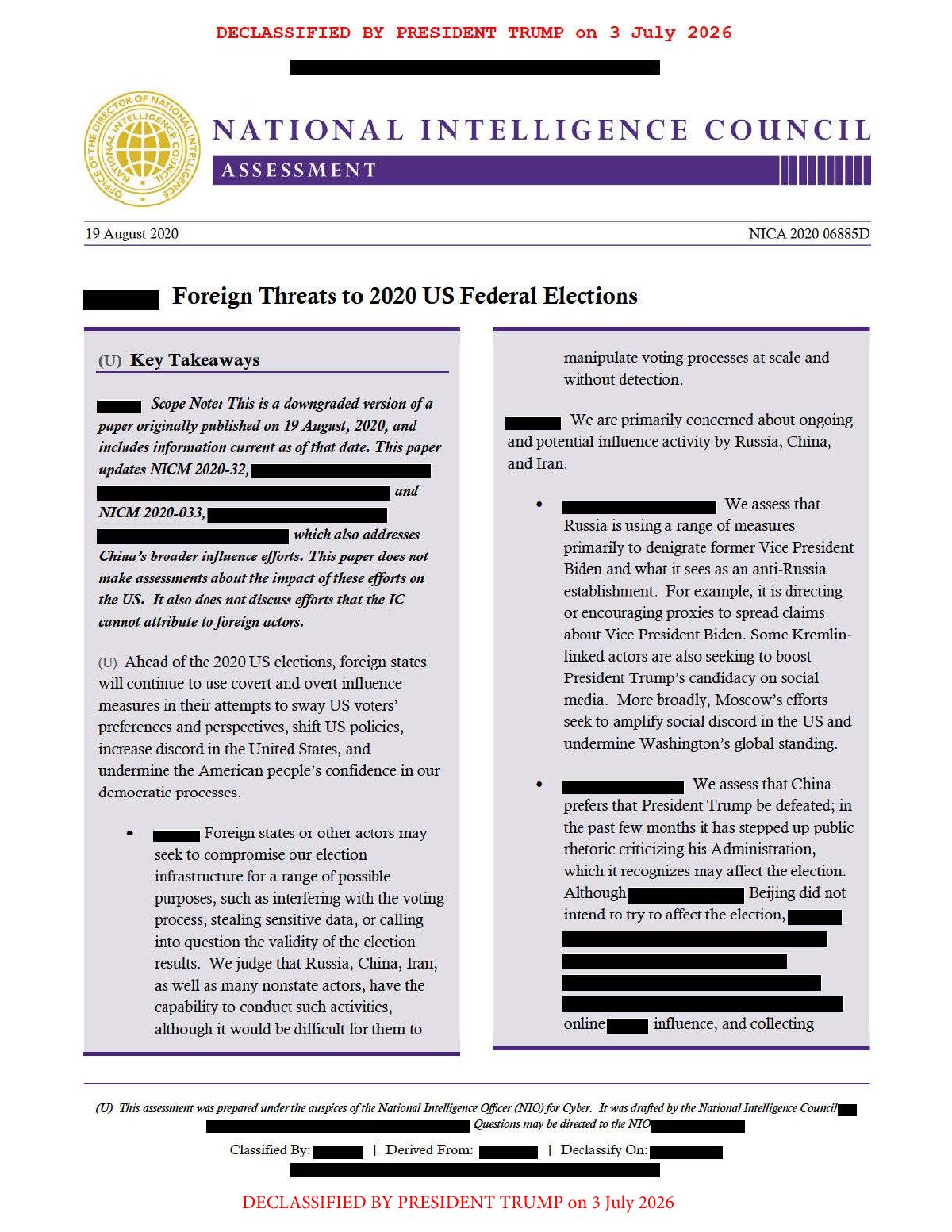
States although [REDACTED, "as of [date]"] Beijing did not intend to try to affect the election, [REDACTED text on] online influence and collecting derogatory information about US [public figures] (p.1, p.3).
p.1China section:China
Declassified by President Trump 3 July 2026
Key Insights
AI-generated from the sourced claims — verify against the documents.
China has expanded cyber collection of data on U.S. political candidates, campaigns, donors, and voter data through opportunistic intrusions against private-sector entities.
If Beijing judged the downward trajectory in US-China relations threatened China's rise, it might attempt to more directly thwart the President's reelection, including by leaking information or through an online influence network.
The scope and scale of China's current influence activity at the state and local level far outpaces Russia's and Turkey's.
16 sourced claims
States although [REDACTED, "as of [date]"] Beijing did not intend to try to affect the election, [REDACTED text on] online influence and collecting derogatory information about US [public figures] (p.1, p.3).
p.1Key takeaway: foreign states will continue to use covert and overt influence measures to sway U.S. voters, shift U.S. policies, increase discord, and undermine confidence in democratic processes; primary concern is Russia, China, and Iran (p.1).
p.1Scope note: downgraded version of a paper originally published 19 August 2020; updates NICM 2020-3 [OCR: NICM 2020-03:3]; addresses China's broader influence efforts; does not assess impact on the U.S. or discuss efforts the IC cannot attribute (p.1).
p.1Assesses Russia, China, Iran, and many nonstate actors have the capability to compromise election infrastructure, though it would be difficult to manipulate voting processes at scale without detection (p.1).
p.1Assesses China prefers President Trump — whom Beijing sees as unpredictable and tough on China — does not win reelection; in the past few months China stepped up public rhetoric criticizing his Administration (p.1, p.3).
p.1Russia section: assesses Russia is using measures to denigrate former VP Biden; names the Lakhta Internet Research (LIR) troll farm, Russia's Foreign Intelligence Service (SVR), and the GRU; references Derkach and Kilimnik as proxy actors; as of June 2020 Russia reconnoitered multiple state and local government [systems] (purpose unknown); in April, unidentified actors used ransomware against a Virginia county administrator and voter registration [system] (p.2-3, p.5, p.7).
p.2Defines "election influence" (activities targeting candidates, parties, voters/preferences, or political processes) and "election interference" (a subset involving technical aspects — voter registration, casting/counting ballots, reporting results) (p.2).
p.2Notes a newspaper owned by the Chinese [government/party] claimed economic measures Beijing could take against supporters of COVID-19 compensation legislation/lawsuits may impact U.S. state and congressional races — the first time the IC observed Beijing issue a public warning suggesting willingness to impose economic costs that could affect U.S. elections (p.4).
p.4China uses mostly enticements and occasionally coercion to extract pro-China positions; employs disinformation and critical statements attacking USG handling of COVID-19, the Houston Consulate closure, Hong Kong, South China Sea legal status, and 5G; a pro-China network of online accounts posted video content critical of President Trump before being deactivated by social media platforms (p.4).
p.4Assesses Beijing probably calculates a concerted effort to influence the presidential election would risk backfiring and offer uncertain benefit, but recognizes critical statements might affect the race (p.4).
p.4Assesses if Beijing judged the downward trajectory in US-China relations threatened China's rise, it might attempt to more directly thwart the President's reelection, including by leaking information [REDACTED] or through an online influence network (p.4).
p.4Threats to Election Infrastructure: hostile actors could exploit internet-connected infrastructure (voter registration databases, pollbooks, election officials' websites); could manipulate vote-counting systems on a localized basis but a wide-scale campaign would be difficult and likely detected by post-election audits and paper trails (p.5).
p.5States Beijing has expanded its cyber collection of data related to the 2020 US elections through opportunistic intrusions against US private-sector entities to collect information on U.S. political candidates, campaigns, donors, and voter data (p.5).
p.5Iran section: conducting an influence campaign to undermine the President; Supreme Leader Khamenei probably authorized it; in January, Iranian-contract cyber actors tried to compromise a server associated with a US business involved in election infrastructure, and the FBI worked with the company to remediate; in June, Google announced Iranian-linked actors unsuccessfully attempted to spearphish campaign staffers' email accounts (p.5-6).
p.5Other foreign actors: senior Turkish officials including President Erdogan sought to covertly influence US politicians (covert funding of US municipal election campaigns, unregistered lobbying); German Chancellor Merkel; Saudi Crown Prince Muhammad Bin Salman (mid-2019) (p.6-7).
p.6Includes a matrix graphic, "Efforts by Selected Countries To Manipulate US Political Landscape," describing efforts over at least the past four years; text notes the scope/scale of China's current influence activity at the state and local level "far outpaces Russia's and Turkey's" (p.8).
p.8Page evidence
NICA — Foreign Threats to 2020 US Federal Elections (19 August 2020) · p.1
Page OCR text
DECLASSIFIED BY PRESIDENT TRUMP on 3 July 2026
eee

NATIONAL INTELLIGENCE COUNCIL
ASSESSMENT TTT

19 August 2020

NICA 2020-06885D

Wa = Foreign Threats to 2020 US Federal Elections

(U) Key Takeaways

Wu «Scope Note: This is a downgraded version of a
paper originally published on 19 August, 2020, and
includes information current as of that date. This paper

updates NICM 2020-3, ra
ee
NICM 2020-03:3,

NN 10: 150 addresses
China’s broader influence efforts. This paper does not

make assessments about the impact of these efforts on
the US. It also does not discuss efforts that the IC
cannot attribute to foreign actors.

(U) Ahead of the 2020 US elections, foreign states
will continue to use covert and overt influence
measures in their attempts to sway US voters’
preferences and perspectives, shift US policies,
increase discord in the United States, and
undermine the American people’s confidence in our
democratic processes.

© ggg Foreign states or other actors may
seek to compromise our election
infrastructure for a range of possible
purposes, such as interfering with the voting
process, stealing sensitive data, or calling
into question the validity of the election
results. We judge that Russia, China, Iran,
as well as many nonstate actors, have the
capability to conduct such activities,
although it would be difficult for them to

manipulate voting processes at scale and
without detection.

Wu «(WV are primarily concemed about ongoing
and potential influence activity by Russia, China,
and Iran.

CW assess that

Russia is using a range of measures
primarily to denigrate former Vice President
Biden and what it sees as an anti-Russia
establishment. For example, it is directing
or encouraging proxies to spread claims
about Vice President Biden. Some Kremlin-
linked actors are also seeking to boost
President Trump’s candidacy on social
media. More broadly, Moscow’s efforts
seek to amplify social discord in the US and
undermine Washington’s global standing.

mu (WV assess that China
prefers that President Trump be defeated; in

the past few months it has stepped up public
rhetoric criticizing his Administration,
which it recognizes may affect the election.
Although gE Beijing did not
intend to try to affect the election, xy
es
eC
|

es
online gg influence, and collecting

(U) This assessment was prepared under the auspices of the National Intelligence Officer (NIO) for Cyber. It was drafted by the National Intelligence Council
NN 201078 112) be direcred 10 rhe NO

Classified By: J =| Derived From: gg =| Declassify On:
|

DECLASSIFIED BY PRESIDENT TRUMP on 3 July 2026