11/16/2021 — an agent wrote he was not comfortable closing the case without raising issues, and was not thrilled with wording stating PIN "concurs" with the decision not to pursue rather than PIN "directing" them not to pursue (p.1).
p.1"Don't Want to Close" Concerns Email Chain (2021)
Internal FBI email chainOct 20, 20213 pagesFBIMichigan 2021 Dont Want To Close Memo RELEASE MARKED.pdf
Key Insights
AI-generated from the sourced claims — verify against the documents.
An agent was not comfortable closing the case without raising issues and objected to wording that PIN 'concurs' with the decision not to pursue rather than PIN 'directing' them not to pursue.
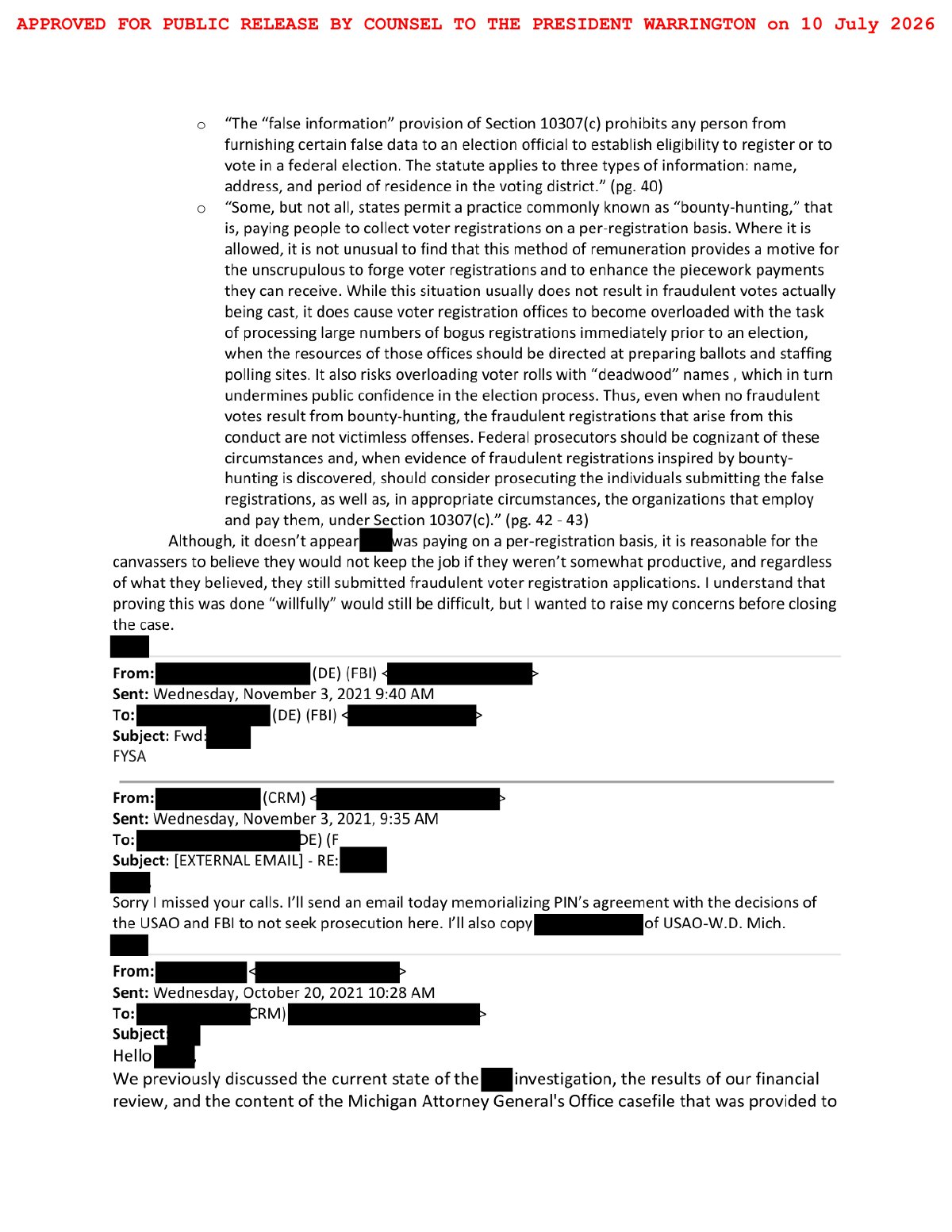
The agent acknowledged canvassers were not paid per-registration but argued they still submitted fraudulent applications, though proving 'willfully' would be difficult.
An external email was to memorialize 'PIN's agreement with the decisions of the USAO and FBI to not seek prosecution here,' copying USAO-W.D. Mich.
6 sourced claims
11/11/2021 — an agent, citing DOJ Public Integrity Section's "Federal Prosecution of Election Offenses" (December 2017), raised concerns about whether closing was appropriate, quoting: election fraud includes conduct intended to corrupt voter registration (pg. 22); submitting fictitious names to election officers (52 U.S.C. §§ 1037(c) [OCR], 20511(2)) (pg. 24); providing false name/address/residence information (pg. 25); and 52 U.S.C. § 10307(c) provisions on false information and payments (pg. 39–43) (p.1–2).
p.1The agent acknowledged it did not appear canvassers were paid per-registration, but argued they still submitted fraudulent applications and that proving "willfully" would be difficult; he wanted concerns raised before closing (p.2).
p.211/3/2021 (external CRM email) — a party would send an email memorializing "PIN's agreement with the decisions of the USAO and FBI to not seek prosecution here," copying USAO-W.D. Mich. (p.2).
p.2The manual passage on "bounty-hunting" (paying per-registration) is quoted at length: it can motivate forging registrations, overloads clerk offices with bogus registrations before an election, and prosecutors should consider charging both individuals and the organizations that employ and pay them under Section 10307(c) (p.2).
p.210/20/2021 — prior discussion of the current state of the investigation, results of the financial review, and the Michigan Attorney General's Office casefile; request for a letter on DOJ/PIN's view on concurrence/nonconcurrence (p.2–3).
p.2Page evidence
"Don't Want to Close" Concerns Email Chain (2021) · p.2
Page OCR text
APPROVED FOR PUBLIC RELEASE BY COUNSEL TO THE PRESIDENT WARRINGTON on 10 July 2026

o “The “false information” provision of Section 10307(c) prohibits any person from
furnishing certain false data to an election official to establish eligibility to register or to
vote in a federal election. The statute applies to three types of information: name,
address, and period of residence in the voting district.” (pg. 40)

o “Some, but not all, states permit a practice commonly known as “bounty-hunting,” that
is, paying people to collect voter registrations on a per-registration basis. Where it is
allowed, it is not unusual to find that this method of remuneration provides a motive for
the unscrupulous to forge voter registrations and to enhance the piecework payments
they can receive. While this situation usually does not result in fraudulent votes actually
being cast, it does cause voter registration offices to become overloaded with the task
of processing large numbers of bogus registrations immediately prior to an election,
when the resources of those offices should be directed at preparing ballots and staffing
polling sites. It also risks overloading voter rolls with “deadwood” names, which in turn
undermines public confidence in the election process. Thus, even when no fraudulent
votes result from bounty-hunting, the fraudulent registrations that arise from this
conduct are not victimless offenses. Federal prosecutors should be cognizant of these
circumstances and, when evidence of fraudulent registrations inspired by bounty-
hunting is discovered, should consider prosecuting the individuals submitting the false
registrations, as well as, in appropriate circumstances, the organizations that employ
and pay them, under Section 10307(c).” (pg. 42 - 43)

Although, it doesn’t appear as paying on a per-registration basis, it is reasonable for the
canvassers to believe they would not keep the job if they weren’t somewhat productive, and regardless
of what they believed, they still submitted fraudulent voter registration applications. | understand that
proving this was done “willfully” would still be difficult, but | wanted to raise my concerns before closing
the case.

=
From: a (O:) (Fc) <e

Sent: Wednesday, November 3, 2021 9:40 AM
To

2 (0€) (6!) aT
Subject: Fwd:

FYSA

From: i (CRM)
Sent: Wednesday, November 3, 2021, 9:35 AM
To: E) (F

Subject: [EXTERNAL EMAIL] - RE:

Sorry | missed your calls. I’ll send an email today memorializing PIN’s agreement with the decisions of
the USAO and FBI to not seek prosecution here. |’ll also copy EEE of USAO-W.D. Mich.

=
From: i TT

Sent: Wednesday, October 20, 2021 10:28 AM

To:

Subject

Hello

We previously discussed the current state of the investigation, the results of our financial
review, and the content of the Michigan Attorney General's Office casefile that was provided to
Page 2 of 3