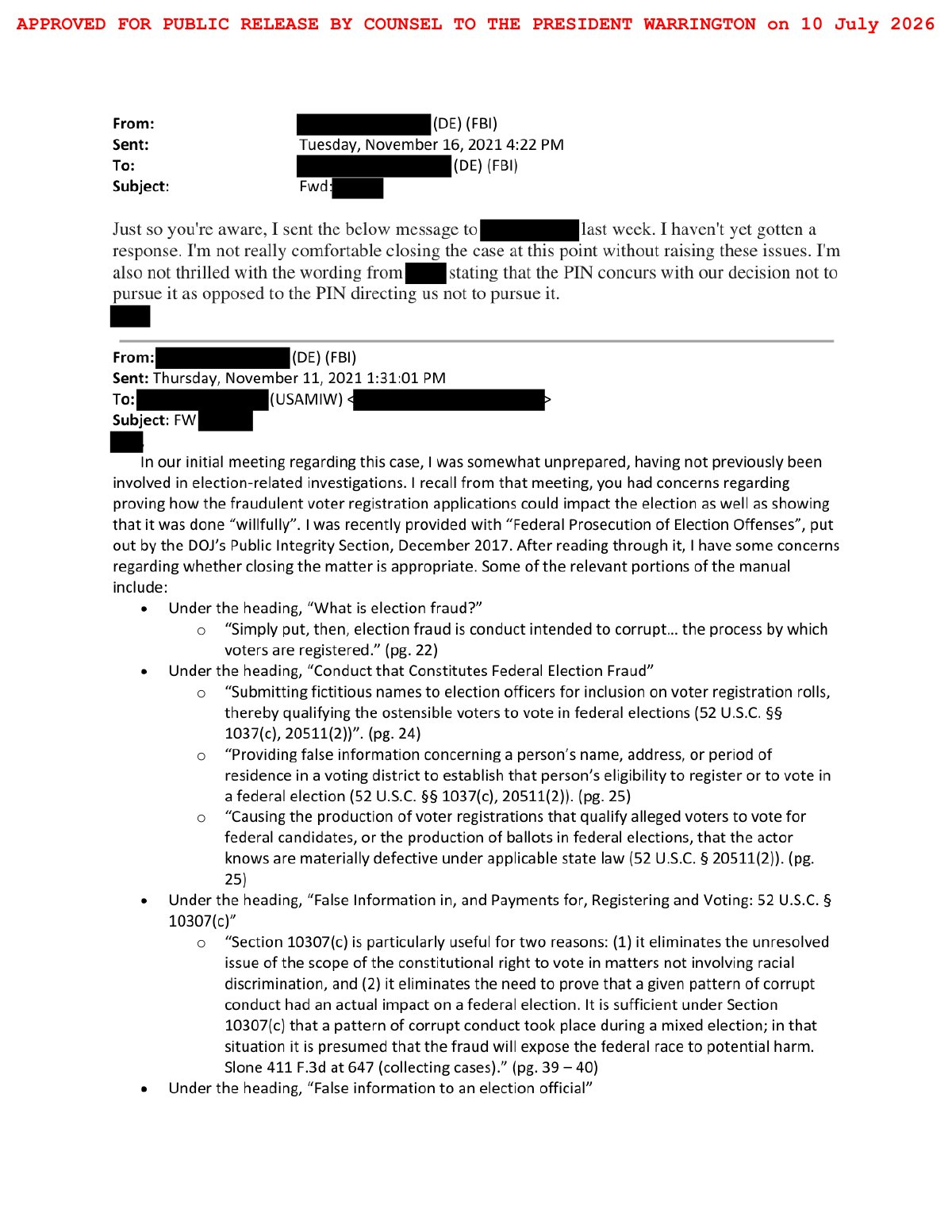
11/16/2021 — an agent wrote he was not comfortable closing the case without raising issues, and was not thrilled with wording stating PIN "concurs" with the decision not to pursue rather than PIN "directing" them not to pursue (p.1).
p.1"Don't Want to Close" Concerns Email Chain (2021)
Internal FBI email chainOct 20, 20213 pagesFBIMichigan 2021 Dont Want To Close Memo RELEASE MARKED.pdf
Key Insights
AI-generated from the sourced claims — verify against the documents.
An agent was not comfortable closing the case without raising issues and objected to wording that PIN 'concurs' with the decision not to pursue rather than PIN 'directing' them not to pursue.
The agent acknowledged canvassers were not paid per-registration but argued they still submitted fraudulent applications, though proving 'willfully' would be difficult.
An external email was to memorialize 'PIN's agreement with the decisions of the USAO and FBI to not seek prosecution here,' copying USAO-W.D. Mich.
6 sourced claims
11/11/2021 — an agent, citing DOJ Public Integrity Section's "Federal Prosecution of Election Offenses" (December 2017), raised concerns about whether closing was appropriate, quoting: election fraud includes conduct intended to corrupt voter registration (pg. 22); submitting fictitious names to election officers (52 U.S.C. §§ 1037(c) [OCR], 20511(2)) (pg. 24); providing false name/address/residence information (pg. 25); and 52 U.S.C. § 10307(c) provisions on false information and payments (pg. 39–43) (p.1–2).
p.1The agent acknowledged it did not appear canvassers were paid per-registration, but argued they still submitted fraudulent applications and that proving "willfully" would be difficult; he wanted concerns raised before closing (p.2).
p.211/3/2021 (external CRM email) — a party would send an email memorializing "PIN's agreement with the decisions of the USAO and FBI to not seek prosecution here," copying USAO-W.D. Mich. (p.2).
p.2The manual passage on "bounty-hunting" (paying per-registration) is quoted at length: it can motivate forging registrations, overloads clerk offices with bogus registrations before an election, and prosecutors should consider charging both individuals and the organizations that employ and pay them under Section 10307(c) (p.2).
p.210/20/2021 — prior discussion of the current state of the investigation, results of the financial review, and the Michigan Attorney General's Office casefile; request for a letter on DOJ/PIN's view on concurrence/nonconcurrence (p.2–3).
p.2Page evidence
"Don't Want to Close" Concerns Email Chain (2021) · p.1
Page OCR text
APPROVED FOR PUBLIC RELEASE BY COUNSEL TO THE PRESIDENT WARRINGTON on 10 July 2026

From: (05) (F8))

Sent: Tuesday, November 16, 2021 4:22 PM
To: (DE) (FBI)
Subject: Fwd

Just so you're aware, I sent the below message to last week. I haven't yet gotten a
response. I'm not really comfortable closing the case at this point without raising these issues. I'm
also not thrilled with the wording from iM stating that the PIN concurs with our decision not to
pursue it as opposed to the PIN directing us not to pursue it.

From: ER (0) (F581)

Sent: Thursday, November 11, 2021 1:31:01 PM
To: (SAM)
Subject: FW

In our initial meeting regarding this case, | was somewhat unprepared, having not previously been
involved in election-related investigations. | recall from that meeting, you had concerns regarding
proving how the fraudulent voter registration applications could impact the election as well as showing
that it was done “willfully”. | was recently provided with “Federal Prosecution of Election Offenses”, put
out by the DOJ’s Public Integrity Section, December 2017. After reading through it, | have some concerns
regarding whether closing the matter is appropriate. Some of the relevant portions of the manual
include:

e Under the heading, “What is election fraud?”

o “Simply put, then, election fraud is conduct intended to corrupt... the process by which
voters are registered.” (pg. 22)

e Under the heading, “Conduct that Constitutes Federal Election Fraud”

o “Submitting fictitious names to election officers for inclusion on voter registration rolls,
thereby qualifying the ostensible voters to vote in federal elections (52 U.S.C. §§
1037(c), 20511(2))”. (pg. 24)

o “Providing false information concerning a person’s name, address, or period of
residence in a voting district to establish that person’s eligibility to register or to vote in
a federal election (52 U.S.C. §§ 1037(c), 20511(2)). (pg. 25)

o “Causing the production of voter registrations that qualify alleged voters to vote for
federal candidates, or the production of ballots in federal elections, that the actor
knows are materially defective under applicable state law (52 U.S.C. § 20511(2)). (pg.
25)

e Under the heading, “False Information in, and Payments for, Registering and Voting: 52 U.S.C. §
10307(c)”

o “Section 10307(c) is particularly useful for two reasons: (1) it eliminates the unresolved
issue of the scope of the constitutional right to vote in matters not involving racial
discrimination, and (2) it eliminates the need to prove that a given pattern of corrupt
conduct had an actual impact on a federal election. It is sufficient under Section
10307(c) that a pattern of corrupt conduct took place during a mixed election; in that
situation it is presumed that the fraud will expose the federal race to potential harm.
Slone 411 F.3d at 647 (collecting cases).” (pg. 39 — 40)

e Under the heading, “False information to an election official”
Page 1 of 3