Prepared by the National Intelligence Officer (NIO) for Cyber and the Director, Election Threat Analysis (D/ETA); offers an alternative perspective to the IC assessment that China has not attempted to influence the 2020 presidential election outcome; provided to the IC for comment but not IC-coordinated (p.1).
p.1Making the Case That China Has Taken Some Steps to Influence the Presidential Election (NICM — Alternative View)
National Intelligence Council MemorandumOct 16, 20207 pagesNICM_ChinaStepsToInfluenceElection_16OCT2020_DECLASS_REDACTED.pdf
declassified by President Trump 3 July 2026
Key Insights
AI-generated from the sourced claims — verify against the documents.
The NIO and D/ETA assess Beijing has taken at least some low-level, exploratory steps to undermine the President's reelection chances by denigrating him and shaping voter perceptions, differing from the IC judgment that Beijing considered but did not deploy influence efforts.
Beijing began taking unspecified steps around 2020 to damage the President's reelection in response to US pressure on China's semiconductor/technology sector; senior leaders expected China's semiconductor industry would continue to be damaged if the President were reelected.
Chinese actors were experimenting with creation of deepfakes intended to denigrate President Trump, in response to directives to improve Beijing's ability to manipulate public opinion.
A pro-China influence network on US social media posted messages denigrating the President; the NIO/D/ETA assess elements of the government were at minimum aware of and condoned the campaign and may have directed it.
20 sourced claims
The NIO and D/ETA assess Beijing has taken at least some low-level, exploratory steps to undermine the President's reelection chances by denigrating him and shaping voter perceptions — differing from the IC judgment that Beijing considered but did not deploy influence efforts (p.1).
p.1They assess Beijing's efforts probably included overt messaging, nascent online covert-influence capabilities, diplomatic measures, and economic leverage, but probably not its most aggressive options [REDACTED], because Beijing wants to minimize blowback and stabilize the relationship post-election (p.1).
p.1The NIO and D/ETA hold low-to-medium confidence, noting much available reporting is consistent with either the mainline or alternative view (p.1).
p.1IC mainline judgment: the IC (including the NIO for East Asia and other NIC officers) assesses Beijing has not deployed influence efforts intended to change the election outcome, believing Chinese leaders desire stability in US-China relations and have tools to achieve goals regardless of winner, and prefer restraint (p.1).
p.1[REDACTED, ~2019] reporting assessed "hostile forces" could fabricate claims that Beijing was interfering to demonize China, and that Beijing should avoid giving Washington a pretext to "scapegoat" China (p.2).
p.2The IC has seen no indication Beijing is engaged in an effort to influence the election outcome, nor activity likely resulting from such an effort; while Beijing has developed [REDACTED] other options usable to influence the election, the IC has not seen them deployed (p.2).
p.2Alternative view indicators: the NIO and D/ETA assess private-sector and open-source reporting suggests the Chinese Government has engaged in at least some level of influence targeting US voters and candidates, knowing it could affect the outcome (p.3).
p.3Beijing began taking unspecified steps around 2020 to damage the President's reelection in response to US pressure on China's [REDACTED — semiconductor/technology] sector; senior leaders expected China's semiconductor industry would continue to be damaged if the President were reelected, and unspecified officials expected sanctions relief if US resolve weakened or a candidate from a named party were elected (p.3).
p.3[REDACTED] recommended China collect derogatory "black materials" on the US President and "sensationalize" them at the appropriate time (p.3).
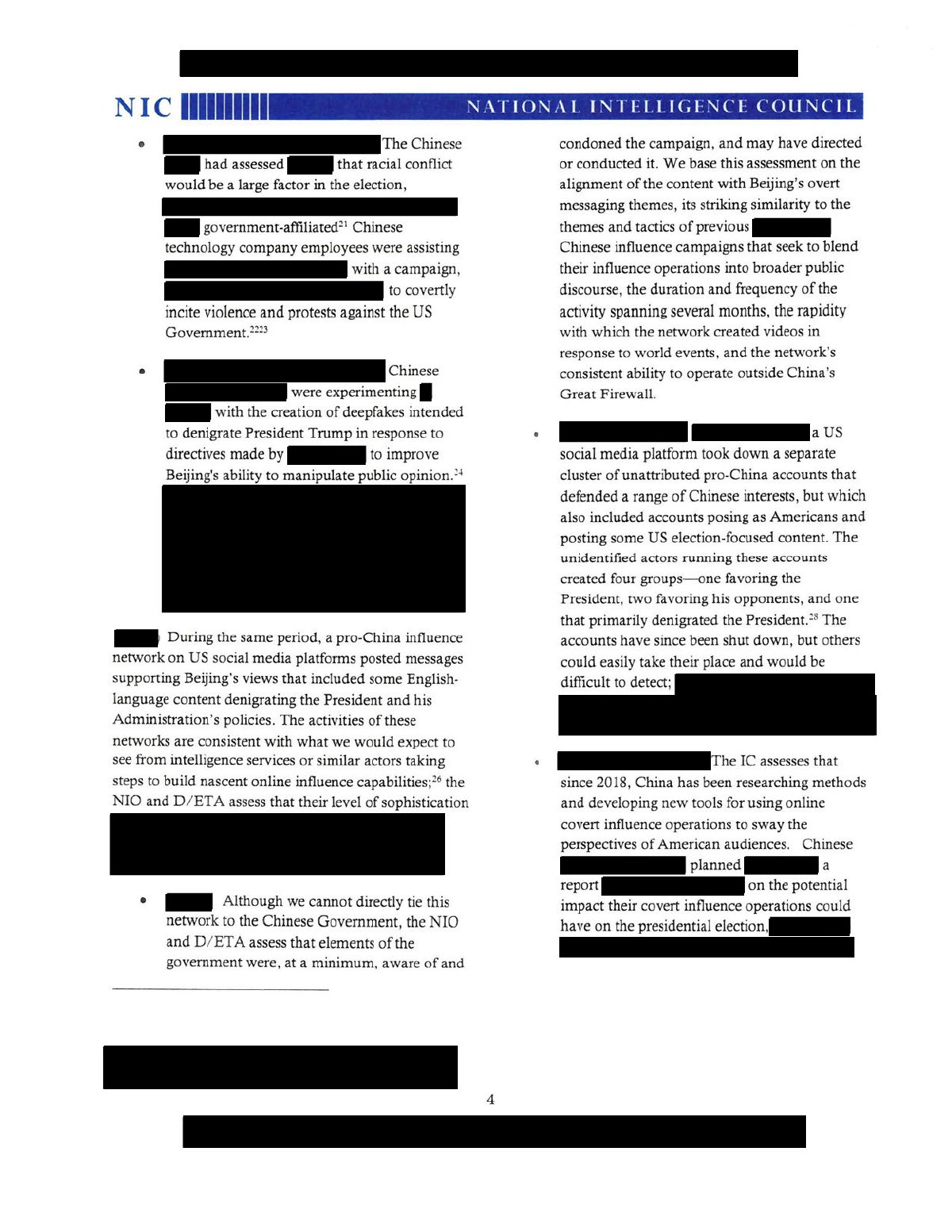
p.3The Chinese Government reportedly tasked its US missions to use Chinese groups/organizations to incite protests to damage the President's standing; [REDACTED] Chinese entities assessed racial conflict would be a large factor and government-affiliated Chinese technology-company employees were assisting [REDACTED] to incite violence and protests (p.3-4).
p.3[REDACTED] Chinese actors were experimenting with creation of deepfakes intended to denigrate President Trump, in response to directives to improve Beijing's ability to manipulate public opinion (p.4).
p.4A pro-China influence network on US social media posted messages (some English-language) denigrating the President; the NIO/D/ETA assess elements of the government were at minimum aware of and condoned the campaign and may have directed it, basing this on content alignment with Beijing's messaging, similarity to prior Chinese campaigns, duration/frequency, rapid video creation in response to world events, and ability to operate outside China's Great Firewall (p.4).
p.4A social media platform took down a separate cluster of unattributed pro-China accounts that created four groups — one favoring the President, two favoring his opponents, and one primarily denigrating the President (p.4).
p.4The IC assesses that since 2018 China has researched methods and developed new tools for online covert influence to sway American audiences (p.4).
p.4A newspaper owned by the Chinese Communist Party claimed economic measures could affect US state and congressional races — the first observed public warning Beijing might impose economic costs affecting US elections; in 2019 [REDACTED] advised gaining leverage over US policy by directing resources to political swing states (p.5).
p.5China from March launched overt and covert influence efforts on COVID-19 messaging, spreading disinformation about pandemic origins and publicizing English-language cartoons denigrating the President's crisis handling (p.5).
p.5Footnote reference: NICM 2019-113, in which the IC warned that because China would probably use the same tactics to influence the election as it uses to influence US policy, the IC might not detect such a pivot (p.5).
p.5Counter-consideration: no reporting suggests China engaged in more aggressive measures (funneling large donations, compromising voting infrastructure, or interfering with mail-in ballots); some elements of state power (e.g., trade) are used ambiguously — China continued buying agricultural products under the Phase One trade deal, which Beijing probably assessed would help the President's reelection and stabilize relations (p.6).
p.6A comparison table ("Comparing Judgments on Chinese Election Influence") contrasts the MINORITY/alternative ASSESSMENT vs. IC judgments across items such as broad influence efforts, probable preference for Trump's defeat, considering/preparing an election-influence effort, risk-vs-gain concerns, preparing for either outcome, avoiding a whole-of-government effort and interference with US election systems, and undertaking a few covert efforts to undermine Trump's reelection; specific marker values are not clearly legible in the OCR [OCR unclear] (p.7).
p.7Page evidence
Making the Case That China Has Taken Some Steps to Influence the Presidential Election (NICM — Alternative View) · p.4
Page OCR text
NIC [UH

+ I 1 Chinese

f | had assessed | that racial conflict

would be a large factor in the election,
a7 government-affiliated*’ Chinese
technology company employees were assisting

SN wes 2 campain,
SE 0 covert

incite violence and protests against the US
Government.**3

SE o:cr- experiencing

7 with the creation of deepfakes intended
to denigrate President Trump in response to

directives made by J to improve

Beijing's ability to manipulate public opinion.

GB During the same period, a pro-China influence
network on US social media platforms posted messages
supporting Beijing's views that included some English-
language content denigrating the President and his
Administration's policies. The activities of these
networks are consistent with what we would expect to
see from intelligence services or similar actors taking
steps to build nascent online influence capabilities;** the
NIO and D/ETA assess that their level of sophistication

GE Although we cannot directly tie this
network to the Chinese Government, the NIO
and D/ETA assess that elements of the
government were, at a minimum, aware of and

NATIONAL INTELLIGENCE COUNCIL

condoned the campaign, and may have directed
or conducted it. We base this assessment on the
alignment of the content with Beijing’s overt
messaging themes, its striking similarity to the
themes and tactics of previous
Chinese influence campaigns that seek to blend
their influence operations into broader public
discourse, the duration and frequency of the
activity spanning several months, the rapidity
with which the network created videos in
response to world events, and the network’s
consistent ability to operate outside China’s
Great Firewall.

Es es :
social media platform took down a separate
cluster of unattributed pro-China accounts that
defended a range of Chinese interests, but which
also included accounts posing as Americans and
posting some US election-focused content. The
unidentified actors running these accounts
created four groups—one favoring the
President, two favoring his opponents, and one
that primarily denigrated the President.** The
accounts have since been shut down, but others
could easily take their place and would be
difficult to detect;

ee IC assesses that

since 2018, China has been researching methods

and developing new tools for using online
covert influence operations to sway the
perspectives of American audiences. Chinese

ES >>: 2
report iE on the potential
impact their covert influence operations could
have on the presidential! election i
ee

|
Page 4 of 7