Product is a CIA Note reflecting a CIA perspective, not coordinated within the Intelligence Community; produced under the Deputy Director of CIA for Analysis (p.2).
p.2Summary of Select Intelligence Reporting from 2004-2020 on Venezuela's Electronic Voting Manipulation Capabilities
CIA NoteJun 29, 20266 pagesCIA Note - Venezuela Machines Intel Memo_29JUNE2026_DECLASS_REDACTED.pdf
declassified by D/CIA Ratcliffe 1 July 2026, approved for public release by Counsel to the President Warrington 10 July 2026
Key Insights
AI-generated from the sourced claims — verify against the documents.
Prior to Venezuela's 2012 presidential election, reporting indicated Chavez's intelligence services worked with the CNE and Smartmatic to plan manipulation of results using preprogrammed voting machines, with plans to deploy altered machines to approximately 300 voting centers to ensure victory by about 1.5 million votes; Chavez won by approximately 1.6 million votes and reportedly congratulated his team for implementing the plan.
In September 2020, Venezuela had developed detailed technical plans to manipulate the December 2020 National Assembly elections using a second set of virtual machines that would replicate legitimate results, then substitute manipulated data while making votes appear to originate from legitimate machines.
The 2006 IC assessment that Smartmatic's ties to Venezuela posed a national-security threat led to US government action forcing Smartmatic to divest its US operations in 2007.
A 2013 CIA alternative analysis outlined a plausible scenario for large-scale electronic manipulation in Venezuela's 2012 election without detection, citing insider access, centralized CNE control, and gaps in opposition monitoring, and noted elections in Venezuela and other client countries 'could be in doubt' if such manipulation occurred.
21 sourced claims
IC reporting from 2004-2020 documented persistent concerns about Venezuelan government manipulation of electronic voting systems, including Smartmatic technology, and potential national-security implications for US election infrastructure (p.2).
p.2The 2006 IC assessment that Smartmatic's ties to Venezuela posed a national-security threat led to US government action forcing Smartmatic to divest its US operations in 2007 (p.2).
p.2CIA's baseline assessments maintained that other factors better explained electoral outcomes; intelligence did not definitively confirm large-scale electronic fraud was successfully executed in specific Venezuelan elections (p.2).
p.2In April 2004, reporting indicated Chavez stated his objective was to prevent the reelection of a sitting US president, suggesting intent to influence US domestic politics; this was part of the basis for the 2006 IC assessment (p.2-3).
p.2The 2006 assessment judged Smartmatic's acquisition of US voting-systems company Sequoia posed a "moderate threat" to US national security (p.3).
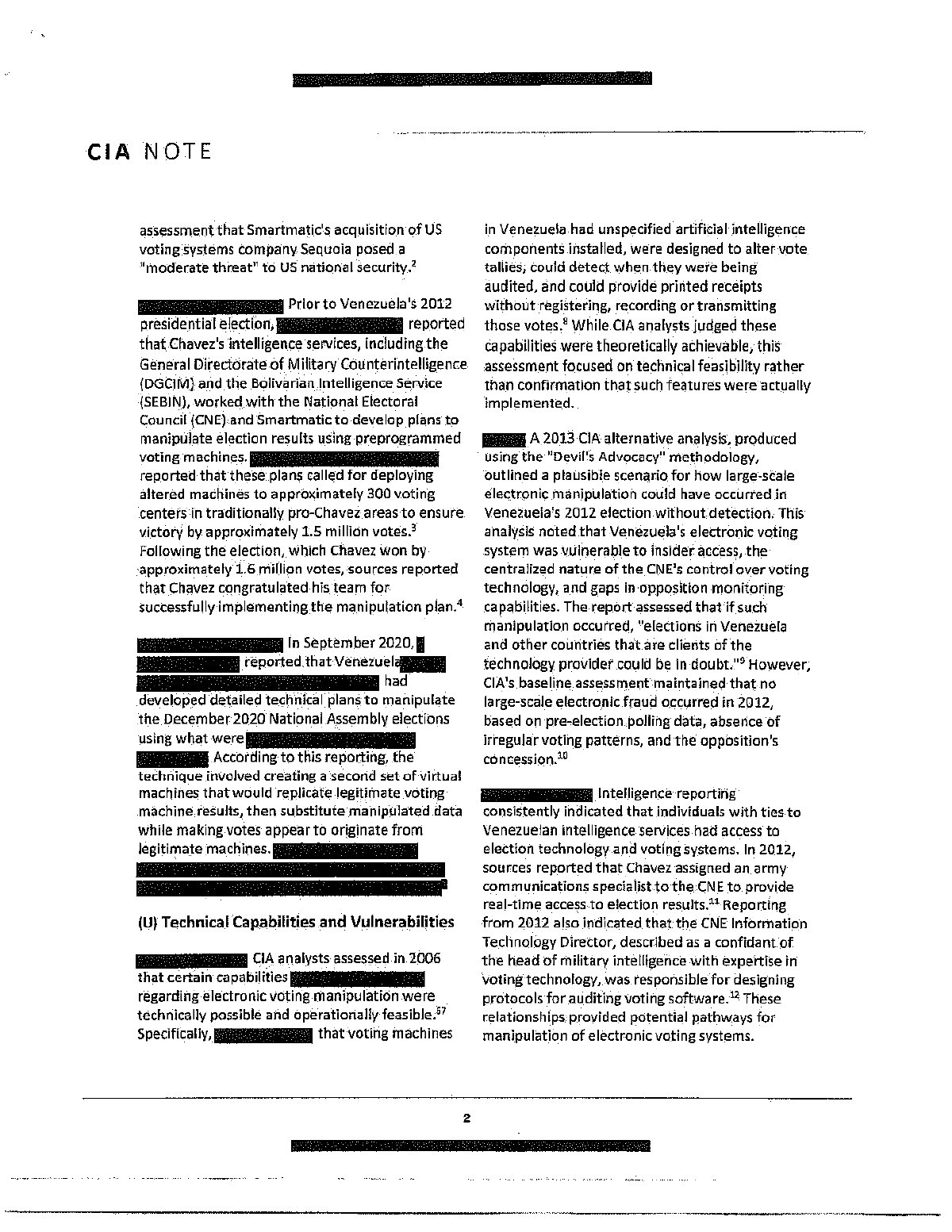
p.3Prior to Venezuela's 2012 presidential election, [REDACTED] reporting indicated Chavez's intelligence services — the General Directorate of Military Counterintelligence (DGCIM) and the Bolivarian Intelligence Service (SEBIN) — worked with the National Electoral Council (CNE) and Smartmatic to plan manipulation of results using preprogrammed voting machines (p.3).
p.3Plans reportedly called for deploying altered machines to approximately 300 voting centers in traditionally pro-Chavez areas to ensure victory by approximately 1.5 million votes; Chavez won by approximately 1.6 million votes and reportedly congratulated his team for implementing the plan (p.3).
p.3In September 2020, [REDACTED] reported Venezuela had developed detailed technical plans to manipulate the December 2020 National Assembly elections using [REDACTED] techniques involving a second set of virtual machines that would replicate legitimate results, then substitute manipulated data while making votes appear to originate from legitimate machines (p.3, p.4).
p.3CIA analysts assessed in 2006 that certain electronic voting-manipulation capabilities were technically possible and operationally feasible; [REDACTED] reporting stated Venezuelan machines had unspecified AI components, were designed to alter tallies, could detect when being audited, and could provide printed receipts without recording or transmitting votes (p.3).
p.3A 2013 CIA alternative analysis using the "Devil's Advocacy" methodology outlined a plausible scenario for large-scale electronic manipulation in Venezuela's 2012 election without detection, citing insider access, centralized CNE control, and gaps in opposition monitoring; it noted elections in Venezuela and other client countries "could be in doubt" if such manipulation occurred (p.3).
p.3CIA's baseline assessment held no large-scale electronic fraud occurred in 2012, based on pre-election polling (Chavez ahead ~10 points), a 24% increase in government spending before the election, the opposition's concession, and quantitative analysis showing no irregular voting patterns (p.3, p.5).
p.3Reporting indicated individuals tied to Venezuelan intelligence services had access to election technology; in 2012 Chavez assigned an army communications specialist to the CNE for real-time access to results, and the CNE IT Director (a confidant of the head of military intelligence) was responsible for designing voting-software audit protocols (p.3).
p.3The September 2020 [REDACTED] technique was allegedly designed to replicate digital hash files sent to the central vote-counting database, mimic real voting machines favoring the ruling party, overwrite hash files of machines favoring the opposition, and make altered votes appear to originate from legitimate machines, using virtual-machine technology to evade standard audits (p.4).
p.4The 2006 National Security Threat Assessment by the National Intelligence Council rated Smartmatic's acquisition of Sequoia Voting Systems a "moderate overall threat," citing Chavez's intent to influence US politics, reported Venezuelan election manipulation with Smartmatic's involvement, [REDACTED] intelligence that Smartmatic directors held Venezuelan intelligence credentials, open-source reporting of corrupt relationships, and Smartmatic/Sequoia contracts in approximately 400 US counties (p.4).
p.4CFIUS pressure resulting from the assessment led Smartmatic to divest its ownership of Sequoia in 2007 (p.4).
p.4In March 2018, Smartmatic ceased operations in Venezuela after publicly accusing the Maduro regime of inflating voter turnout by over one million votes in the August 2017 National Constituent Assembly election, figures that diverged from Smartmatic's machine data (p.4).
p.4Analytic caveat: the 2006 IC assessment concluded neither Smartmatic nor the Venezuelan Government had the capability to manipulate an election outside Venezuela in a predictable fashion, because such manipulation rested on controlling every stage of the process (acquisition, security, programming, receipt storage, audit) — a spectrum of access unavailable outside Venezuela (p.5).
p.5Analytic caveat: the 2013 Devil's Advocacy report was explicitly an alternative-analysis exercise, acknowledging "conflicting [REDACTED] reporting" and "limited insight into key elements of the electronic voting system" (p.5).
p.5Analytic caveat: [REDACTED] judged the regime did not need to resort to gross fraud to win the December 2020 National Assembly elections, given the opposition boycott and the regime's co-optation of opposition party leadership (p.5).
p.5Page 6 contains only the "CIA NOTE" header with no substantive body text in the OCR [OCR unclear] (p.6).
p.6Reporting at the time
External context — third-party coverage published around these events, linked for reference. Separate from the primary documents.
Page evidence
Summary of Select Intelligence Reporting from 2004-2020 on Venezuela's Electronic Voting Manipulation Capabilities · p.3
Page OCR text
CIA NOTE

assessment that Smartmatic's acquisition of US
voting systems company Sequoia posed.a
“moderate threat” to US national security.”

Prior to Venezuela's 2012

aS A SE
presidential election, Eames reported

that Chavez's intelligence services, including the
General Directorate. of Military Counterintelligence
{DGCIM)} and the Bolivarian. Intelligence Service
{SEBIN),-worked with the National Electoral
Council (CNE):and Smartmatic to.develop plans to
manipulate election results using preprogrammed
voting machines.
reported that these plans called for deploying
altered machinés to approximately 300 voting
‘centeys:in traditionally pro-Chavez areas to ensure.
victory by approximately 1.5 million votes.?
Following the election, which Chavez won by.
“approximately 1.6 million votes, sources reported
that Chavez congratulated his team for.
successfully implementing the manipulation plan.*

RE (n September 2020, 8
EE «(e ported that Venezuela
had
developed detailed technical plans to manipulate
the December 2020 National Assembly elections
using What were [aaa
foe According to this reporting, the
technique involved creating a‘second set of virtual
machines that would replicate legitimate voting:
machine results, then substitute’ manipulated data
while making votes appear to originate from
legitimate machines. aaa aaa
pe EE
ee gy

(Uy Technical Capabilities and Vulnerabilities

Es CA analysts assessed in. 2006
that certain capabilities Igaaareaanneamerna

regarding electronic voting manipulation were |
technically pessible and operationally feasible.®”

Specifically, Raaeaameaeeee that voting machines

in Venezuela had unspecified artificial intelligence
components installed, were designed to alter vote
tallies; could detect when-they were being
audited, and could provide printed receipts
without registering, recording or transmitting
those votes.* While.CIA analysts judged these
capabilities were theoretically achievable, this
assessment focused on technical feasibility rather
than confirmation that such features were a ctually
implemented. .

aman A 2013 CIA alternative analysis, produced

‘using the "Devil's Advocacy" methodology,

outlined a plausible scenario for how large-scale
électronic manipulation could have occurred in
Venezuela's 2012 election without.detection. This
analysis noted that Venezuela's electronic voting
system was vuinerable to insider é access, the:
centralized nature of the CNE’s contro! over voting
technology, and gaps in opposition monitoring
capabilities. The report assessed that if such
manipulation occurred, "elections in Venezuela
and other countries that are clients of the
technology provider could be in: doubt."® However,
CIA's baseline. assessment maintained that.no
large-scale electronic fraud occurred in 2012,
based on pre-election.polling data, abserice of
irregular voting patterns, and the oppositions
concession?

SEES Intelligence reporting

consistently indicated that individuals with ties.to
Venezuelan intelligence services.had access ta
election technology.and voting systems. In 2012,
sources reported that Chavez assigned an army:
communications specialist-to the-CNE to. provide
real-time access.to election results.*+ Reparting
from 2012 also indicated that the CNE Information
Technology Director, described as a confidant of
the head of military intelligence with expertise in
Voting technology, was. responsible for designing
protocols for auditing voting software.*? These
relationships: provided potential pathways for
manipulation of electronic voting systems.Page 3 of 6