States it contains portions of sensitive reporting disseminated between 2018 and 2020 related to the PRC, and is not a comprehensive synopsis (p.2).
p.2CIA Note — Sensitive PRC Reporting from 2018-2020
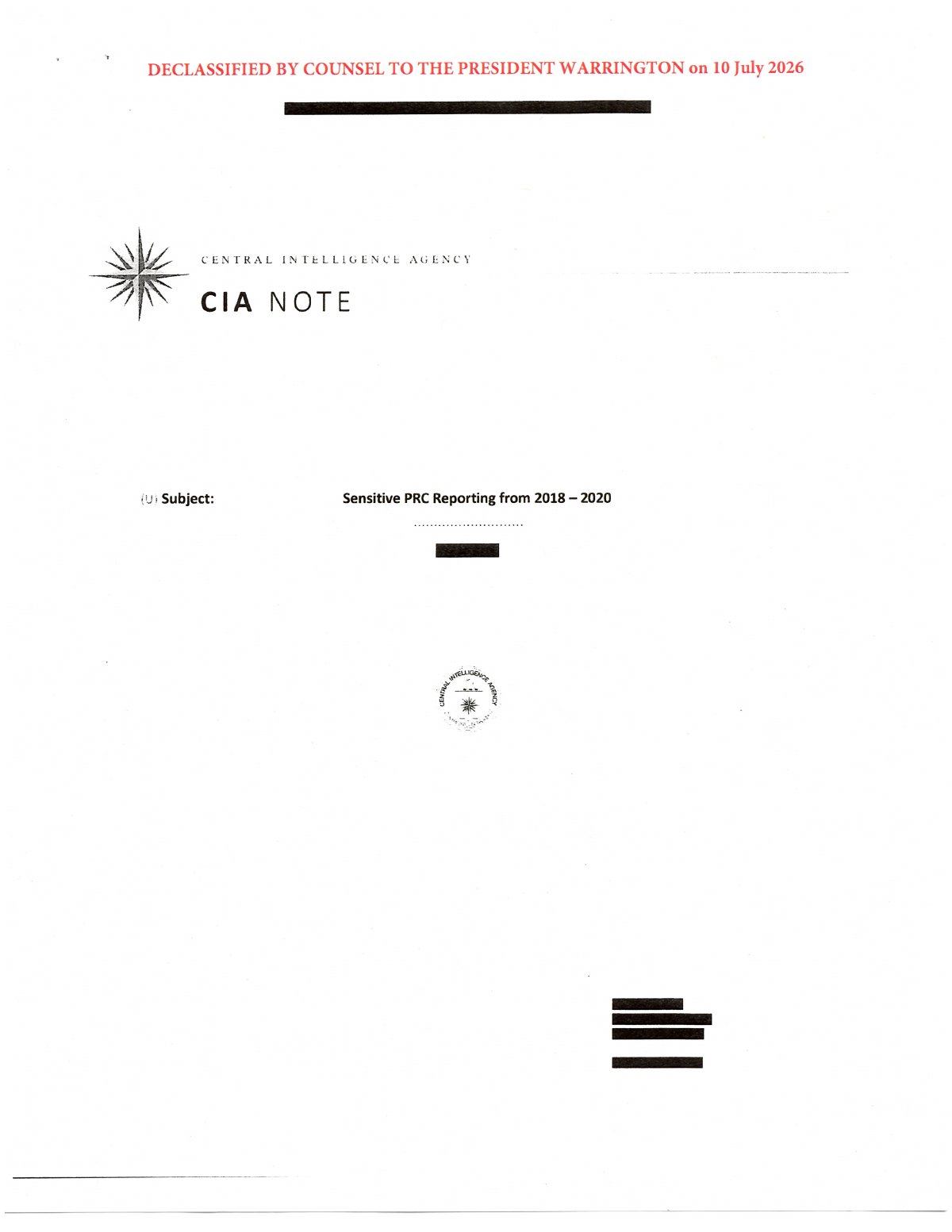
CIA NoteJul 10, 20263 pagesNote - Sensitive PRC Reporting from 2018-2020 DECLASS_REDACTED.pdf
Declassified by Counsel to the President Warrington 10 July 2026
Key Insights
AI-generated from the sourced claims — verify against the documents.
Mid-2018: the Chinese Communist Party's policy was to leverage all domestic and foreign elements opposed to the U.S. President to reduce his votes and make him resign or prevent his re-election.
Mid-2018: China was working to influence the results of the U.S. mid-term elections and later the 2020 U.S. Presidential elections; China was analyzing the 2016 U.S. Presidential elections and identifying U.S. states that voted for the President, then targeting sectors within those states with tariffs on exports to China to induce their representatives to lobby the President.
Mid-2019: China's strategy focused on undermining domestic confidence in the President, using Chinese contracts with big U.S. companies to influence business leaders against him, and seeking to identify and pay U.S. journalists who reported negatively on the President to write more negative articles; the Chinese Government wanted the President to lose the next election.
Describes China extending paid speaking invitations (with first-class travel/accommodation) to influential U.S. individuals — effective with think tank officials, academics, and former U.S. government employees — to get U.S. corporations/individuals 'hooked on China' and thereby pressure them to talk with the U.S. President.
7 sourced claims
Mid-2018: the Chinese Communist Party's policy was to leverage all domestic and foreign elements opposed to the U.S. President to reduce his votes and make him resign or prevent his re-election (p.2).
p.2Mid-2018: China was working to influence the results of the U.S. mid-term elections and later the 2020 U.S. Presidential elections; China was analyzing the 2016 [OCR: "2015"] U.S. Presidential elections and identifying U.S. states that voted for the President, then targeting sectors within those states with tariffs on exports to China to induce their representatives to lobby the President (p.2).
p.2Mid-2018: assessed the PRC's ultimate goal regarding U.S. elections was for the President not to be re-elected; China found the uncertainty of the U.S. administration unsettling (p.2).
p.2Describes China extending paid speaking invitations (with first-class travel/accommodation) to influential U.S. individuals — effective with think tank officials, academics, and former U.S. government employees — to get U.S. corporations/individuals "hooked on China" and thereby pressure them to talk with the U.S. President (p.2).
p.2Mid-2019: China assessed directing additional resources toward political swing states, viewing them as crucial for the 2020 election, and recommended applying pressure to financial supporters of the President's re-election campaign (p.2-3).
p.2Mid-2019: China's strategy focused on undermining domestic confidence in the President, using Chinese contracts with big U.S. companies to influence business leaders against him, and seeking to identify and pay U.S. journalists who reported negatively on the President to write more negative articles; the Chinese Government wanted the President to lose the next election (p.3).
p.3Page evidence
CIA Note — Sensitive PRC Reporting from 2018-2020 · p.1
Page OCR text
DECLASSIFIED BY COUNSEL TO THE PRESIDENT WARRINGTON on 10 July 2026

NZ CENTRAL INTELLIGENCE AGENCY

AK CIA NOTE

‘Ui Subject: Sensitive PRC Reporting from 2018 — 2020

seein,

gonad!

CENT,
i cle
Men
4,
Page 1 of 3