From ~2019 to 2024, CISA conducted technical and operational activities to evaluate certain US election systems, all upon request of system owners/operators, including software examination, penetration testing of SLTT (state, local, tribal, and territorial) networks, and incident response for election-system intrusions (p.1).
p.1Election Report (CISA)
CISAJul 13, 20266 pagesCISA Election Report - FINAL.pdf
Key Insights
AI-generated from the sourced claims — verify against the documents.
Structural constraints in the certification ecosystem limit vendors' ability to patch quickly; some certification regimes require that no patches be applied for months before an election, so systems are deployed with known, unpatched issues.
In multiple cases CISA assessors gained full network control within hours or days, showing many SLTT partners remain 'soft targets'.
Vendor threat models assume strong segmentation between election systems and enterprise IT, but 2019-2024 assessments showed election systems reachable from enterprise hosts via shared auth domains, legacy VLANs, or 'temporary' exceptions; poor firewall hygiene; co-location on general-purpose virtualization clusters; and unreliable 'airgap' assumptions.
The Critical Product Evaluation program created disincentives for transparent, industry-standard vulnerability disclosure; it was retired in 2024 based on stakeholder feedback.
In 2020, ImageCast X Ballot Marking Devices printed ballots encoding selections in a barcode voters could not verify, and a researcher showed hackers could change the barcode-encoded votes without physical machine access.
22 sourced claims
CISA notified the owner/operator in every case it identified a vulnerability in a product or network and encouraged mitigation (p.1).
p.1Structural constraints in the certification ecosystem limit vendors' ability to patch quickly; some certification regimes require that no patches be applied for months before an election, so systems are deployed with known, unpatched issues (p.1).
p.1SLTT election-office IT networks frequently lack cybersecurity hygiene; election infrastructure is often accessible from general enterprise networks, enabling lateral movement by adversaries who compromise email, workstations, or other IT assets (p.1).
p.1US election security is shaped by three factors: (1) software vulnerability management constrained by outdated certification regimes; (2) inconsistent vendor transparency on vulnerabilities and patch status; (3) cybersecurity immaturity of many SLTT networks (p.1).
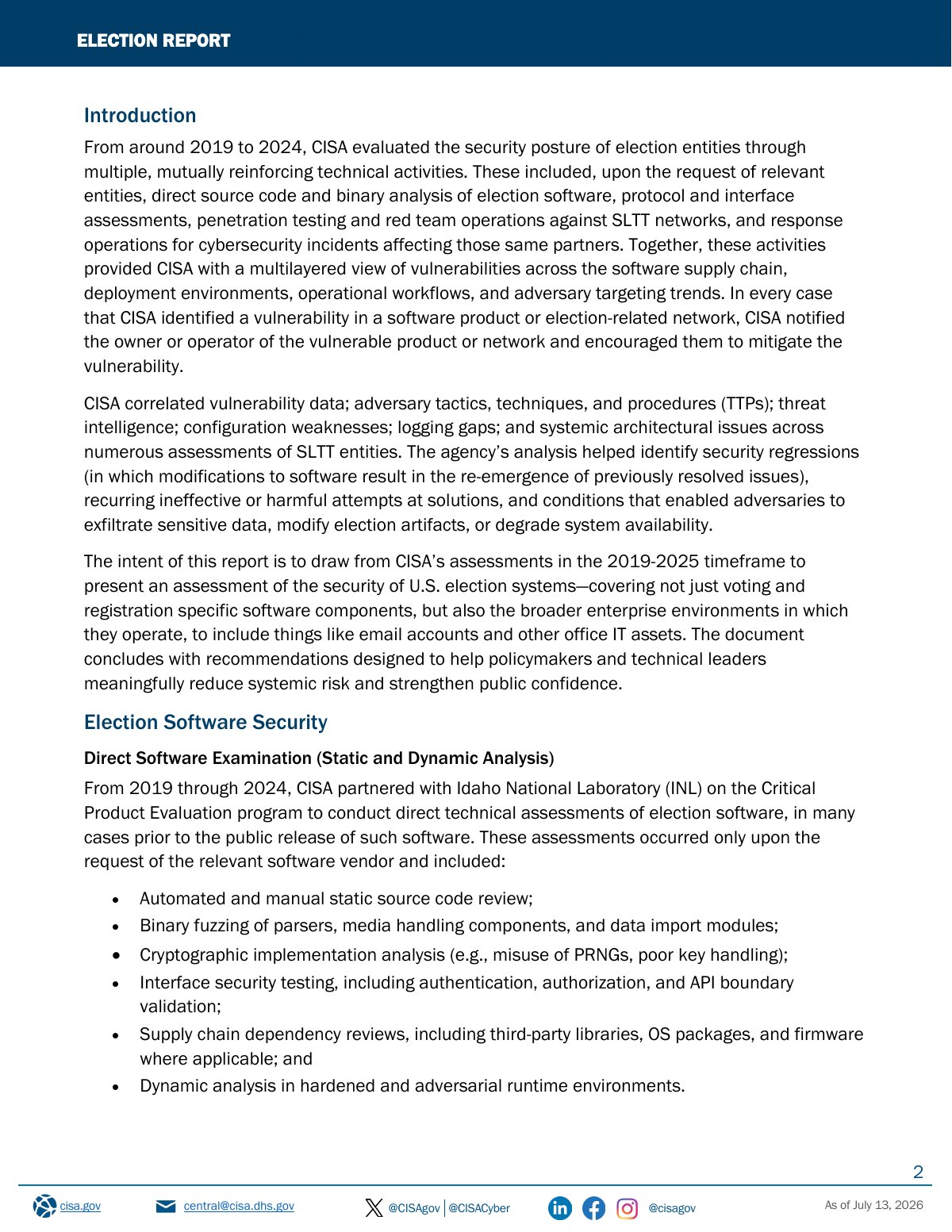
p.1From 2019-2024 CISA partnered with Idaho National Laboratory (INL) on the Critical Product Evaluation program for direct technical assessments of election software, often before public release, upon vendor request (p.2).
p.2Assessment methods included static source-code review, binary fuzzing of parsers/media handling/data import modules, cryptographic implementation analysis (PRNG misuse, poor key handling), interface/authentication/authorization/API testing, supply-chain dependency reviews, and dynamic analysis in adversarial runtime environments (p.2).
p.2The Critical Product Evaluation program created disincentives for transparent, industry-standard vulnerability disclosure; it was retired in 2024 based on stakeholder feedback, with final reporting concluding in 2025 (p.3).
p.3Vulnerabilities found included input-validation bugs, insecure deserialization, insufficient logging, race conditions, insecure crypto primitives, and privilege-escalation paths; CISA did not independently validate whether production builds in SLTT environments incorporated all fixes (p.3).
p.3SLTT officials face update difficulties due to minimal IT budgets/staff, short deployment windows, and "lockdown" periods (sometimes mandated by state law) barring changes before election day; state laws may require only EAC (Election Assistance Commission)-certified software, delaying updates that postdate certification (p.3).
p.3Technical risks: vendors cannot ship fixes outside narrow certification cycles without jeopardizing eligibility; third-party components (OS, drivers, middleware, crypto libraries) cannot be patched at modern cadence; legacy OS baselines accumulate unpatched vulnerabilities; absence of secure auto-update prevents rapid zero-day response (p.3).
p.3CISA recommends national policymakers encourage harmonization of patch-management and certification rules (p.4).
p.4Across penetration tests and red-team engagements, CISA observed flat/minimally segmented networks, weak identity and access management (poor MFA, shared credentials, weak service-account hygiene), lack of endpoint hardening, legacy remote-access/file-transfer pathways, and insufficient traffic monitoring (p.4).
p.4In multiple cases CISA assessors gained full network control within hours or days, showing many SLTT partners remain "soft targets" (p.4).
p.4Most states have moved away from paperless electronic voting machines; in 2020, ImageCast X Ballot Marking Devices printed ballots encoding selections in a barcode voters could not verify, and a researcher showed hackers could change the barcode-encoded votes without physical machine access (p.4).
p.4Citation given: J. Alex Halderman, Security Analysis of Georgia's ImageCast X Ballot Marking Devices, expert report in Curling v. Raffensperger (Civil Action No. 1:17-CV-2989-AT, N.D. Ga.), with Drew Springall, July 1, 2021 (p.4).
p.4ODNI commissioned a forensic examination of Dominion Voting Systems devices used in Puerto Rico's 2024 election; CISA reviewed the report but did not have access to the devices and could not perform its own examination (p.4).
p.4Citation given: Dominion Voting Systems Democracy Suite Preliminary Vulnerability Assessment, Mojave Research for the ODNI, September 25, 2025 (p.4).
p.4Vendor threat models assume strong segmentation between election systems (voter-registration databases, e-pollbooks, election management/tabulation systems, central scanning) and enterprise IT, but 2019-2024 assessments showed election systems reachable from enterprise hosts via shared auth domains, legacy VLANs, or "temporary" exceptions; poor firewall hygiene; co-location on general-purpose virtualization clusters; and unreliable "airgap" assumptions (vendor support tunnels, remote-management tools) (p.5).
p.5CISA recommended mitigations: harmonize patch/certification rules; adhere to CISA Best Practices for Securing Election Systems; use human-readable paper ballots; conduct post-election manual audits of paper ballots before certification (p.5-6).
p.5Additional recommendations: encourage vendors to assign CVE numbers, notify customers if source code is leaked/stolen, report incidents to authorities, include a software bill of materials (SBOM); and ensure transparent documentation of all security incidents and remediation (p.6).
p.6Conclusion: US election-system security issues stem from complex interdependencies between vendors, certifiers, policymakers, and resource-constrained SLTT partners, not any single entity (p.6).
p.6Reporting at the time
External context — third-party coverage published around these events, linked for reference. Separate from the primary documents.
Page evidence
Election Report (CISA) · p.2
Page OCR text
ELECTION REPORT

Introduction

From around 2019 to 2024, CISA evaluated the security posture of election entities through
multiple, mutually reinforcing technical activities. These included, upon the request of relevant
entities, direct source code and binary analysis of election software, protocol and interface
assessments, penetration testing and red team operations against SLTT networks, and response
operations for cybersecurity incidents affecting those same partners. Together, these activities
provided CISA with a multilayered view of vulnerabilities across the software supply chain,
deployment environments, operational workflows, and adversary targeting trends. In every case
that CISA identified a vulnerability in a software product or election-related network, CISA notified
the owner or operator of the vulnerable product or network and encouraged them to mitigate the
vulnerability.

CISA correlated vulnerability data; adversary tactics, techniques, and procedures (TTPs); threat
intelligence; configuration weaknesses; logging gaps; and systemic architectural issues across
numerous assessments of SLTT entities. The agency’s analysis helped identify security regressions
(in which modifications to software result in the re-emergence of previously resolved issues),
recurring ineffective or harmful attempts at solutions, and conditions that enabled adversaries to
exfiltrate sensitive data, modify election artifacts, or degrade system availability.

The intent of this report is to draw from CISA’s assessments in the 2019-2025 timeframe to
present an assessment of the security of U.S. election systems—covering not just voting and
registration specific software components, but also the broader enterprise environments in which
they operate, to include things like email accounts and other office IT assets. The document
concludes with recommendations designed to help policymakers and technical leaders
meaningfully reduce systemic risk and strengthen public confidence.

Election Software Security

Direct Software Examination (Static and Dynamic Analysis)

From 2019 through 2024, CISA partnered with Idaho National Laboratory (INL) on the Critical
Product Evaluation program to conduct direct technical assessments of election software, in many
cases prior to the public release of such software. These assessments occurred only upon the
request of the relevant software vendor and included:

e Automated and manual static source code review;
e Binary fuzzing of parsers, media handling components, and data import modules;
e Cryptographic implementation analysis (e.g., misuse of PRNGs, poor key handling);

e Interface security testing, including authentication, authorization, and API boundary
validation;

e Supply chain dependency reviews, including third-party libraries, OS packages, and firmware
where applicable; and

e Dynamic analysis in hardened and adversarial runtime environments.

2

‘er

cisa.gov Wa central@cisa.dhs.gov X @CISAgov | @CISACyber ‘in) £) @cisagov As of July 13, 2026
Page 2 of 6