The job was to stand outside businesses asking people to register; there were over 100 people doing the same job in the Muskegon area; employees were paid based on how many completed registrations they submitted each day (p.1).
p.1Canvasser Interview — Widespread Fake Registrations
FBI FD-302 interview reportDec 12, 20233 pagesFBIMichigan Witness Interview Widespread Fake Registrations RELEASE MARKED.pdf
Key Insights
AI-generated from the sourced claims — verify against the documents.
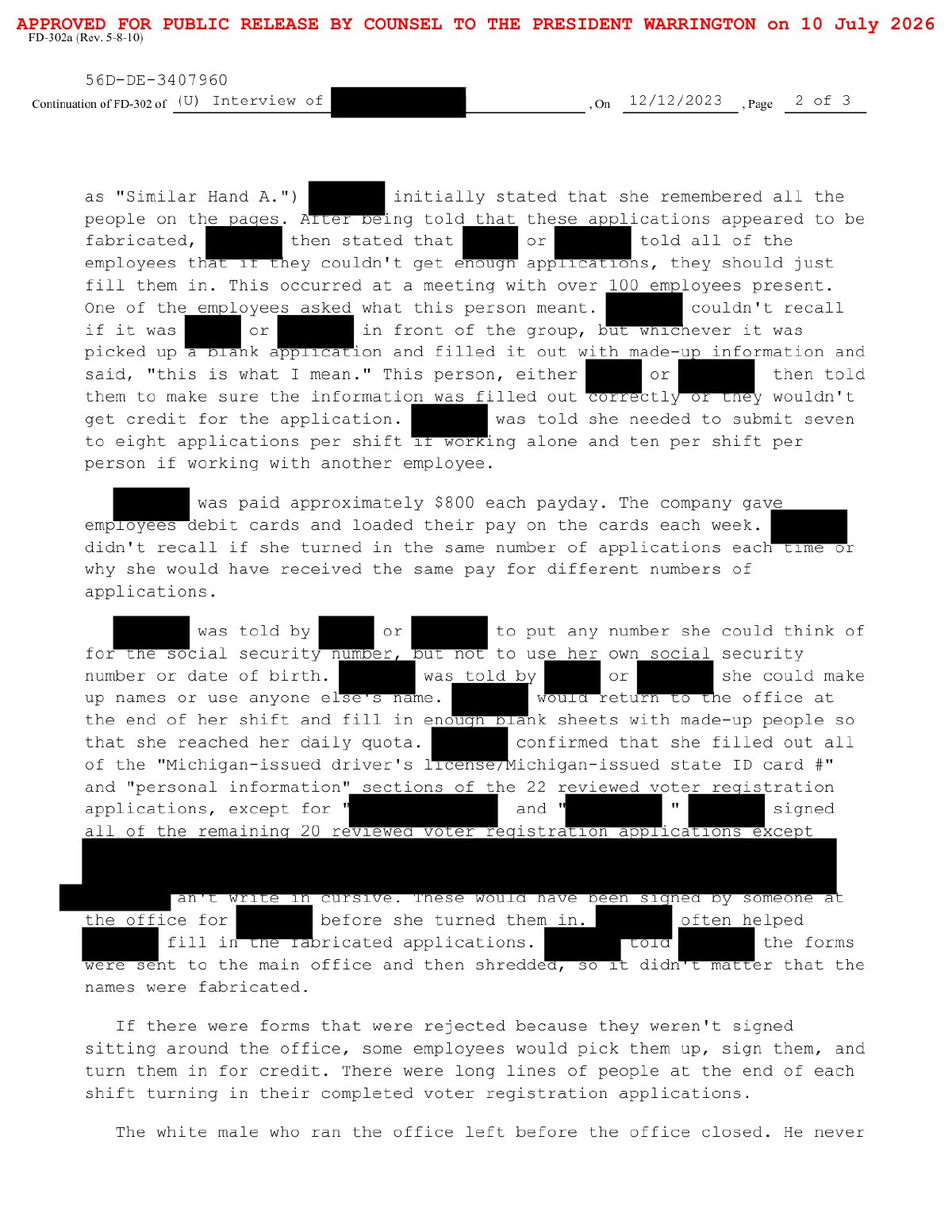
A supervisor explicitly instructed over 100 employees to 'just fill them in' and demonstrated by filling out a blank application with made-up information, directing them to submit fake registrations if they couldn't get enough real ones.
Rejected unsigned forms were picked up by other employees, signed, and turned in for credit, indicating a systematic practice of recycling and falsifying applications.
The operation was described as 'huge' with operations in other states, and the office was shut down immediately after a police search warrant was executed.
11 sourced claims
In Fall 2020 the witness was hired at an office (previously an eyeglass store) to register people to vote; the office was run by a tall, thin white male (p.1).
p.1The white male told employees the organization was huge with operations in other states and that the best performers could travel to other states to work (p.1).
p.1Once police executed the search warrant at the office, employees were told the job assignment was over (p.1).
p.1She was told to submit seven to eight applications per shift working alone, or ten per shift per person when working with another employee; she was paid approximately $800 each payday via debit cards loaded weekly (p.2).
p.2The witness confirmed she filled out two canvasser contracts and was shown 22 completed applications ("Similar Hand A"); after being told the applications appeared fabricated, she stated that a supervisor `[REDACTED]` told all employees that if they couldn't get enough applications they should "just fill them in," demonstrated at a meeting of over 100 employees by filling out a blank application with made-up information and saying "this is what I mean" (p.2).
p.2She was instructed by a supervisor to put any number for the SSN (but not her own SSN or DOB) and could make up names or use anyone else's name; she would return to the office and fill in enough blank sheets with made-up people to reach her daily quota (p.2).
p.2Rejected unsigned forms left around the office would be picked up, signed, and turned in for credit by some employees; there were long lines at the end of each shift turning in applications (p.2).
p.2She stated it "would not surprise" her that there were thousands of fake applications; she blamed the supervisor and the white male; there were no posters or instructions telling employees not to turn in fake applications; she said employees were "just doing what they were told" and knew it was fraud (p.2–3).
p.2She noted a couple of black males (described by height/build) who "always worked together and seemed fishy" and whispered to each other; she did not know if the group was trying to impact the election or make money (p.3).
p.3The witness estimated she personally submitted 100 fake voter-registration applications with made-up information; she collected legitimate applications during the same period (p.3).
p.3Page evidence
Canvasser Interview — Widespread Fake Registrations · p.2
Page OCR text
APPROVED FOR PUBLIC RELEASE BY COUNSEL TO THE PRESIDENT WARRINGTON on 10 July 2026
-302a (Rev. 5-8-10)

56D-DE-3407960

Continuation of FD-302 of (U) Interview of PF (On 12/12/2023 page 2 of 3

as "Similar Hand A.") a initially stated that she remembered all the
people on the _ pages. After being told _ that these applications appeared to be
fabricated, ie stated that Z or a told all of the
employees that 1 ey couldn't get enougn applications, they should just
fill them in. This occurred at a meeting with over 100 employees present.
One of the _ employees asked what this person meant. oe recall
if it was | or a in front of the group, but whichever it was
picked up a ank application and filled it out with made-u
said, "this is what I mean." This person, either or

information and
them to make sure the information was filled out correctly or ey wouldn't

get credit for the application. a was told she needed to submit seven
to eight applications per shift 1f working alone and ten per shift per

person if working with another employee.

|| was paid approximately $800 each payday. The company gave

employees debit cards and loaded their pay on the cards each week. | |
didn't recall if she turned in the same number of applications each Time or
why she would have received the same pay for different numbers of

or a to put any number she could think of
for e social security number ut not to use her own social security
number or date of birth. pe was _told b = or she could make
up names or use anyone else’s name. iy return to e office at

the end of her shift and fill in enou ank sheets with made-up people so
that she reached her daily quota. Oi oc: that she filled out all

of the "Michigan-issued driver's license

applications.

was told by

ichigan-issued state ID card #"

and "personal information" sections of the 22 reviewed voter registration

applications, except for ' and ' " a signed
ications except

all of the remainin

20 reviewed voter registr

ys
often helped

the forms
er that the

the office for a she turned them in.
fill in e€ Trabricated applications.

were sent to the main office and then shredded, didn ma

names were fabricated.

If there were forms that were rejected because they weren't signed
sitting around the office, some employees would pick them up, sign them, and
turn them in for credit. There were long lines of people at the end of each
shift turning in their completed voter registration applications.

The white male who ran the office left before the office closed. He never
Page 2 of 3