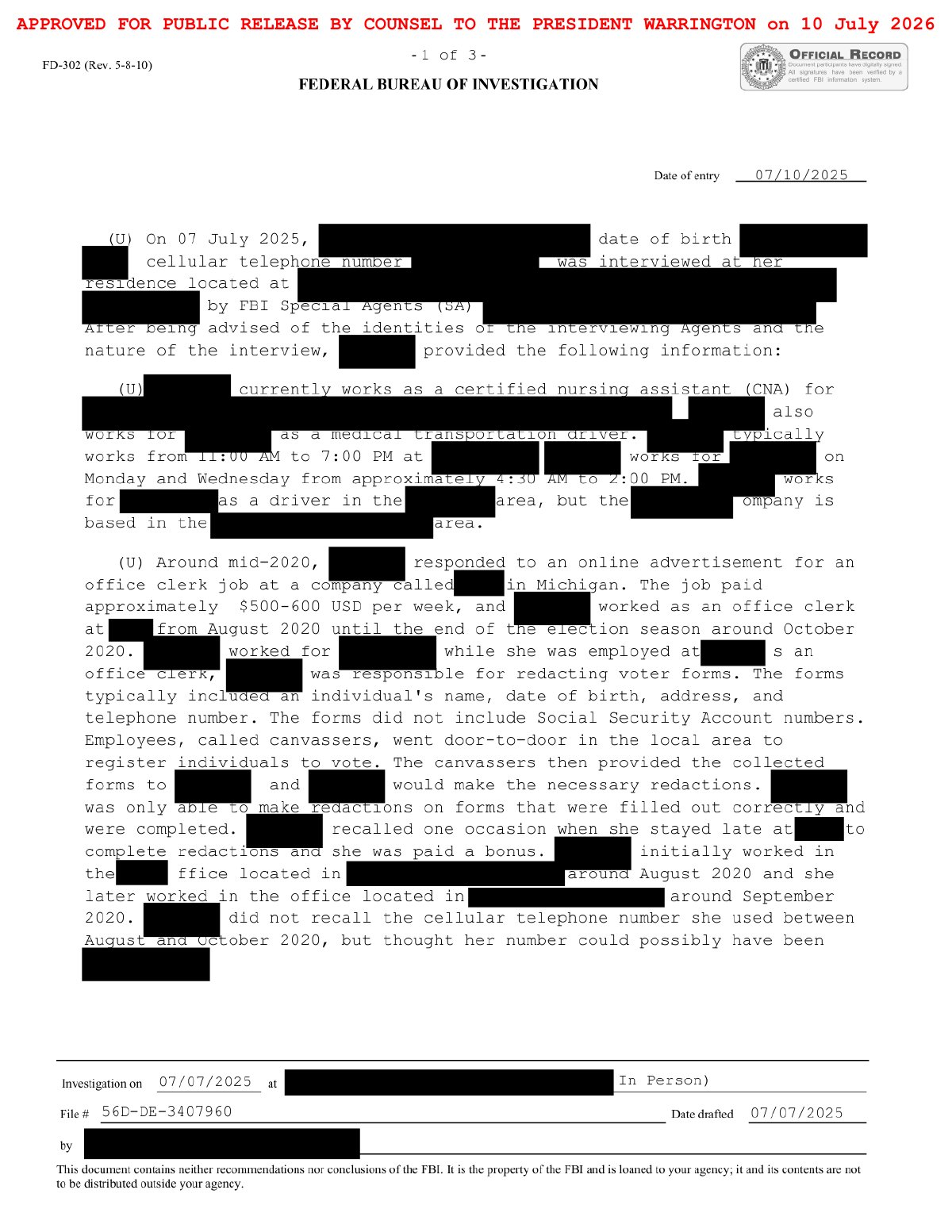
Around mid-2020 the witness (a CNA) responded to an online advertisement for an office-clerk job at a company `[REDACTED]` in Michigan, paying approximately $500–$600 per week; she worked from August 2020 until the end of the election season around October 2020 (p.1).
p.1Office Clerk Interview — Gift Cards / "Suppress Trump" (2025)
FBI FD-302 interview reportJul 7, 20253 pagesFBIMichigan Witness Interview Memo Gift Cards Suppress Trump RELEASE MARKED.pdf
Key Insights
AI-generated from the sourced claims — verify against the documents.
The witness stated she felt the organization was 'possibly trying to suppress or prevent [people] from voting for President Trump' (p.3).
The witness was responsible for redacting voter forms (name, DOB, address, phone) collected by canvassers going door-to-door, and could only redact forms filled out correctly (p.1).
Canvassers were paid approximately $10/hour plus a $50 bonus for collecting a certain amount of forms, with pay loaded to debit cards that frequently had problems (p.3).
9 sourced claims
As an office clerk she was responsible for redacting voter forms (name, DOB, address, phone; no SSNs on the forms); canvassers went door-to-door to register individuals and provided the collected forms for redaction; she could only redact forms filled out correctly and once stayed late and was paid a bonus (p.1).
p.1She worked in one office in August 2020 and later a second office around September 2020; she said working for the organization felt "like working for a mobster" (p.1–2).
p.1A supervisor `[REDACTED]` ran morning Zoom/teleconference meetings directing canvassers to fill out forms completely and correctly (incomplete forms could not be processed) and directed the clerk not to redact incomplete forms; the witness was never given contact information for that supervisor (p.2).
p.2She described a female "VP" (vice president) — a light-skinned black female who helped hire, handled onboarding and problems, and operated like a manager over rooms — and a second female employee (dark-skinned black female handling financial matters); the two ran an office that operated as a headquarters (p.2).
p.2There was a room she was not allowed into that she presumed was an office; she referenced someone possibly involved in selling Social Security numbers but could not provide additional information (p.2–3).
p.2Canvassers were paid approximately $10/hour plus a $50 bonus for collecting a certain amount of forms; pay was loaded to debit cards that frequently had problems; canvassers had to provide an ID and SSN to activate the cards; daily meetings were held around 9:00–9:30 AM (p.3).
p.3She did not know if anyone submitted false applications, did not conspire to submit false applications, and was never paid or offered compensation to submit false applications (p.3).
p.3After her time there, she stated she felt the organization was "possibly trying to suppress or prevent [people] from voting for President Trump" (p.3).
p.3Page evidence
Office Clerk Interview — Gift Cards / "Suppress Trump" (2025) · p.1
Page OCR text
APPROVED FOR PUBLIC RELEASE BY COUNSEL TO THE PRESIDENT WARRINGTON on 10 July 2026

-l1 of 3- > OrriciaL Recorp

FD-302 (Rev. 5-8-10)

FEDERAL BUREAU OF INVESTIGATION

Date of entry 07/10/2025

U) On O07 July 2025,
cellular telephone number

Was interviewed at her

gents an

residence located at
by FBI Specila

er being advised of the_identities o e interviewing

nature of the interview, provided the following information:

currently works as a certified nursing assistant (CNA) for

to 7:00 PM at
Monday and Wednesday from approximate

works from on

for as a driver in the but the ompany is

based in the

(U) Around mid-2020,
office clerk job at a company calle

responded to an online advertisement for an
in Michigan. The job paid

approximately $500-600 USD per week, and worked as an office clerk
at

2020.

from August 2020 until the end of tne election season around October

worked for

while she was employed a im s an

office clerk, a was responsible for redacting voter forms. The forms
typically included an individual's name, date of birth, address, and
telephone number. The forms did not include Social Security Account numbers.
Employees, called canvassers, went door-to-door in the local area to

register individuals to vote. The canvassers then provided the collected

forms to and

would make the necessary redactions.
was only able to make redactions on forms that were filled out correctly and
recalled one occasion when she stayed late at ko
complete redactions and she was paid a bonus. initially worked in
the ffice located in August 2020 and she

later worked in the office located in] around September

2020. did not recall the cellular telephone number she used between

a an Ctober 2020, but thought her number could possibly have been

were completed.

File# 56D-DE-3407960 Date drafted 07/07/2025

This document contains neither recommendations nor conclusions of the FBI. It is the property of the FBI and is loaned to your agency; it and its contents are not
to be distributed outside your agency.
Page 1 of 3